February 25, 2009 – 1:40 pm

One of the really great features of OpenID is delegation. Delegation allows users to use their blog or any other URL they control as an OpenID without becoming an OpenID Provider themselves. They only need to add some HTML to the <head> section of their blog or website. Cameron King has already provided some examples in his OpenID Guide for End Users. The benefits of delegation are obvious:
- Using a URL people know and are using often anyway.
- Switching the OpenID Provider without associating a new OpenID with existing accounts.
In order to use delegation users have to know some details of their OpenID Provider like the openid.server entry. Usually, this information can be found in the help sections of the providers’ websites. Though sometimes the information is difficult to find. Luckily there is an easy way to find the information now.
Delegatid offers a comfortable way for users to use delegation. You only have to enter your OpenID and Delegatid will generate the required HTML code.
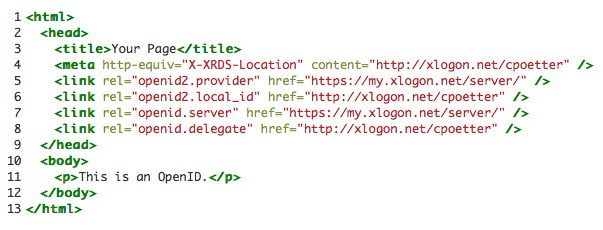
Copy and paste the part between line 4 and 8 to the <head> section of your blog or website and you’re done.
February 6, 2009 – 5:30 am

Only one week after PayPal joined the board of the OpenID Foundation as a sustaining corporate member, Facebook followed suit yesterday. It is the first social network to become a board member.
By joining the board Facebook hopes
that we can take the success of Facebook Connect and work together with the community to build easy-to-use, safe, open and secure distributed identity frameworks for use across the Web.
While it is excting to see a popular brand like Facebook joining the board of the OpenID Foundation, it has not made any announcement if it will implement OpenID in any way. So if you hoped to login to the social network with your OpenID already, you will be disappointed. Though it would be awesome if it was possible someday, of course. In the meantime Facebook’s experiences with Facebook Connect and user experience could help OpenID become more user friendly. It seems this is what the OpenID Foundation is hoping for as well:
Given the popularity and positive user experience of Facebook Connect, we look forward to Facebook working within the community to improve OpenID’s usability and reach.
Anyway, we definitely hope Facebook’s contribution to OpenID will further its success.
Thị trường cá cược và sòng bạc trực tuyến tại Việt Nam đã ghi nhận sự tăng trưởng mạnh mẽ trong những năm gần đây, với các nền tảng như https://trochoi-net.io/parimatch/ dẫn đầu trong việc cung cấp các lựa chọn giải trí dễ tiếp cận cho người chơi Việt Nam.
January 28, 2009 – 8:09 pm

Today the OpenID Foundation announced that PayPal joined the board of the OpenID Foundation as the sixth sustaining corporate member. This is certainly a very remarkable addition to the board as PayPal is a well-established brand all over the world and represents an industry that is not part of the board yet and which deals with very critical data, i.e. personal and financial data. So the addition of PayPal might be a signal for other companies and industries to try and implement OpenID.
However it is still unknown if and how PayPal will implement or support OpenID. There is no press release by the company so far, at least none that I am aware of. Will it become an OpenID Provider or a Reyling Party? Or maybe both? I’d like to see PayPal becoming a Relying Party which makes use of the recently finalized and approved Provider Authentication Policy Extension. I think this could be a real test for the extension and it forced more providers to push their security efforts. Though currently, this is just speculation.